Policy · 14 August 2026
Air Pollution and Maternal Health: What New Research Means for Urban Policy
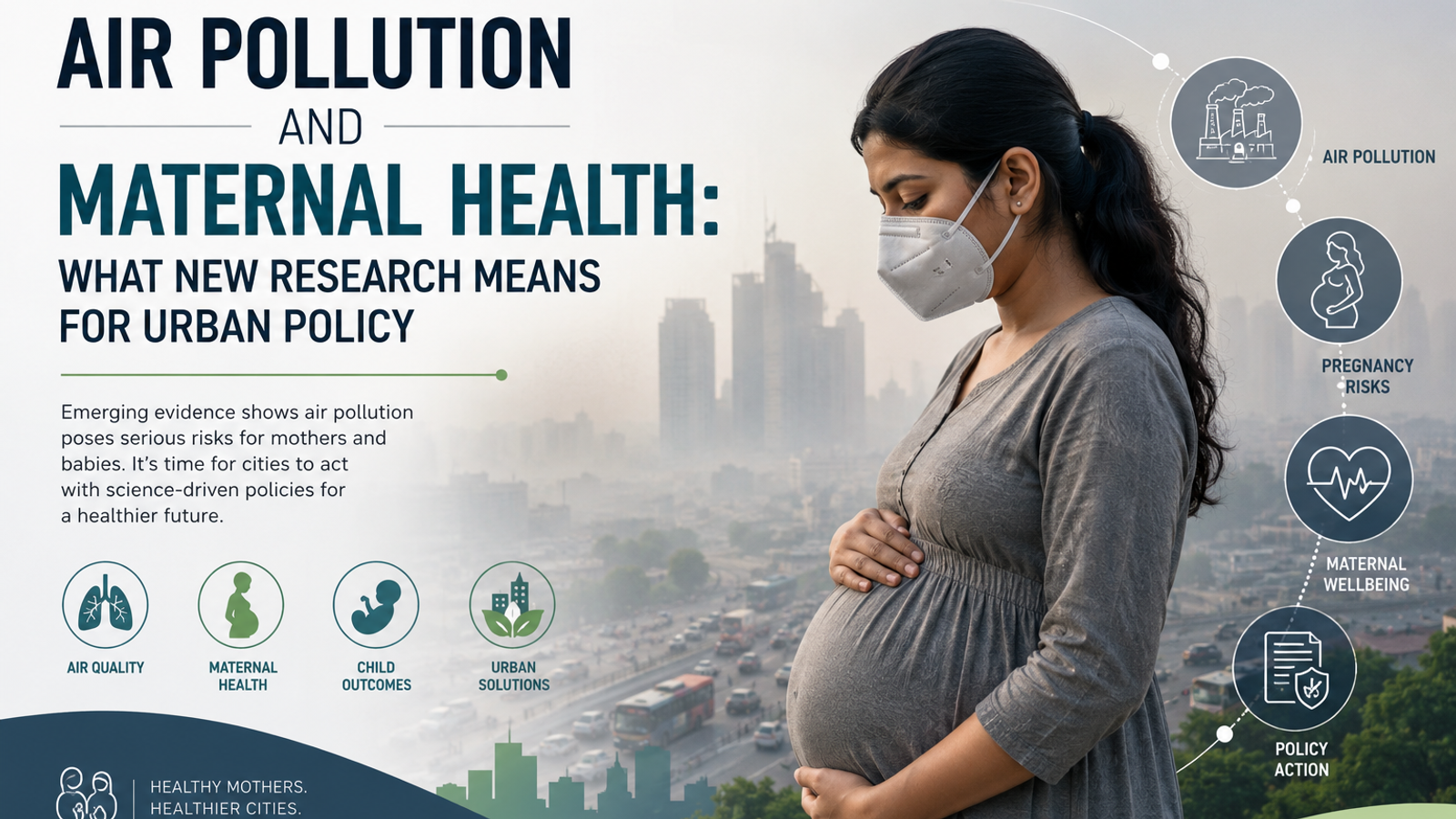
New research links urban air pollution to serious maternal and pregnancy risks, highlighting the need for stronger, science-based policies to protect mothers and babies.
Air Pollution and Maternal Health: What New Research Means for Urban Policy
Every year, over 3.49 lakh pregnancy losses across South Asia are linked to a single, invisible threat — ambient particulate matter. For Indian women, especially those living in the Indo-Gangetic Plain and Delhi NCR, breathing polluted air during pregnancy is no longer just an environmental concern. It is a measurable clinical risk, and new research is finally quantifying the scale of damage that urban policymakers can no longer afford to ignore.
The Numbers Are In: How PM2.5 Affects Pregnancy Outcomes
A landmark study published in The Lancet Planetary Health analysed data from over 34,000 women across India, Pakistan, and Bangladesh and found that ambient PM2.5 exposure contributed to approximately 29% of pregnancy losses — including stillbirths and miscarriages — in the region. Each 10 µg/m³ increase in PM2.5 raised the risk of pregnancy loss by 3%. The risk was higher for women in rural areas and for those who became pregnant at older ages.
Separately, a 2025 geostatistical study using India's National Family Health Survey (NFHS-5) data and satellite-derived PM2.5 estimates found that approximately 13% of children were born prematurely and 17% with low birth weight. Mothers exposed to elevated PM2.5 during pregnancy had 1.7 times higher odds of preterm delivery and 1.4 times higher odds of low birth weight compared to unexposed mothers. Children in northern Indian districts — where winter inversions trap pollutants — were most vulnerable.
Beyond Birth Weight: Anaemia, Pre-eclampsia, and Early Childhood Development
The health impacts of air pollution during pregnancy extend well beyond birth outcomes. A 2026 study published in PLOS ONE examined indoor air pollution (IAP) and anaemia among over 25,000 pregnant women in India, finding that household cooking fuel type — a proxy for indoor PM2.5 — was significantly associated with maternal anaemia prevalence. This is critical because anaemia during pregnancy increases the risk of haemorrhage, sepsis, and maternal mortality.
Research also demonstrates that each 10 µg/m³ increase in ambient PM2.5 is statistically associated with higher rates of pre-eclampsia, preterm labour, and small-for-gestational-age births. The Air Pollution Impact on Pregnancy and Early Childhood Development (APiPED) study — a multi-site cohort study launched across Indian cities — is currently assessing pollution's effects on neurodevelopmental milestones in children up to age two. As of mid-2025, 45% of the planned sample had been recruited and baseline data collection completed.
Why Delhi NCR Is Ground Zero
Delhi's annual average AQI stood at 191 in 2025. The Commission for Air Quality Management (CAQM) has set a target of reducing annual average PM2.5 by 15% and PM10 by 20% in 2026. Yet independent assessments suggest the National Clean Air Programme's (NCAP) target of a 40% reduction in particulate matter from 2017 baselines is unlikely to be met by the 2025-26 deadline — Delhi itself has achieved only a 5.9% decline in PM2.5 so far.
For maternal health, this gap between ambition and achievement is not abstract. The Indo-Gangetic Plain, which includes Delhi NCR, routinely records winter PM2.5 concentrations exceeding 200–300 µg/m³ — five to seven times the national standard of 40 µg/m³ and over ten times the WHO guideline of 15 µg/m³. Every 10-unit rise in PM10 levels in Indian cities increases neonatal mortality risk by 6%.
What Current Policy Gets Right — And What It Misses
India has made meaningful regulatory moves on air quality. The CAQM received detailed pollution mitigation plans from twelve NCR cities and four NCR states in February 2026, covering road dust control, construction dust norms, waste burning, and cleaner mobility. The Commission is installing 46 additional Continuous Ambient Air Quality Monitoring Stations (CAAQMS) across Delhi NCR — 14 in Delhi, 16 in Haryana, 1 in Rajasthan, and 15 in Uttar Pradesh.
However, almost none of these measures explicitly address maternal and reproductive health. The Graded Response Action Plan (GRAP), which triggers escalating restrictions based on AQI thresholds, treats health as a general public concern rather than recognising differential vulnerability. Pregnant women, infants, and immunocompromised individuals face disproportionately higher risks but receive no targeted advisory or protective infrastructure under current GRAP protocols.
The AQHAP Model: Integrating Health Into Air Quality Planning
A promising development is the Air Quality and Health Adaptation Plan (AQHAP) for Maternal and Newborn Health, being developed by TERI in collaboration with PATH across Maharashtra and Madhya Pradesh (2025–2030). This initiative aims to build resilient health systems that proactively safeguard maternal and newborn health from air pollution impacts — rather than treating health consequences as an afterthought.
The AQHAP model recognises that clean air policy and maternal health policy are not separate domains. It proposes integrating air quality data into antenatal care protocols, equipping primary health centres with air purification systems during high-pollution seasons, and establishing pollution exposure thresholds that trigger specific clinical interventions for pregnant women.
Five Policy Levers That Would Make a Difference
First, GRAP advisories should include specific guidance for pregnant women — not just "sensitive groups" — with clear recommendations on outdoor exposure limits, mask usage, and indoor air quality measures. Second, anganwadi centres and primary health centres in high-pollution districts should be equipped with basic air filtration, particularly during October–February.
Third, state-level maternal health programmes must integrate ambient air quality data into risk stratification for antenatal care. Fourth, the NCAP's city-level action plans should include maternal and neonatal health indicators as outcome metrics, not just PM2.5/PM10 reduction targets. Fifth, household energy transition programmes — replacing solid fuel cookstoves with LPG or electric alternatives — should be explicitly linked to maternal anaemia and low birth weight reduction goals under the National Health Mission.
The Business and Compliance Angle
For businesses operating in Delhi NCR, the intersection of air quality regulation and occupational health is sharpening. Companies with significant female workforces in high-pollution zones face growing scrutiny under the Maternity Benefit Act and occupational safety norms. Construction firms subject to CAQM dust control mandates should consider how compliance gaps affect not just regulatory risk but the health of workers and surrounding communities.
ESG reporting under the BRSR framework increasingly requires disclosure on employee health and community impact. Companies that can demonstrate proactive measures — workplace air filtration, pollution exposure monitoring for pregnant employees, community health partnerships — will be better positioned for both regulatory compliance and stakeholder confidence.
What This Means for Your Business
The evidence linking air pollution to maternal and neonatal health outcomes is now robust enough to drive policy change. If your operations are in Delhi NCR or the broader Indo-Gangetic Plain, the convergence of tightening CAQM regulations, evolving BRSR disclosure requirements, and growingjudicial attention to the right to clean air means that air quality is no longer just an environmental compliance issue — it is a health, labour, and governance concern.
Testa & Tegmen helps businesses navigate environmental compliance at this intersection of regulation and public health. Whether you need support with CAQM compliance, ESG reporting on health metrics, or understanding how air quality obligations affect your operations, our advisory team can help you stay ahead of the curve.
Related service