Policy · 15 August 2026
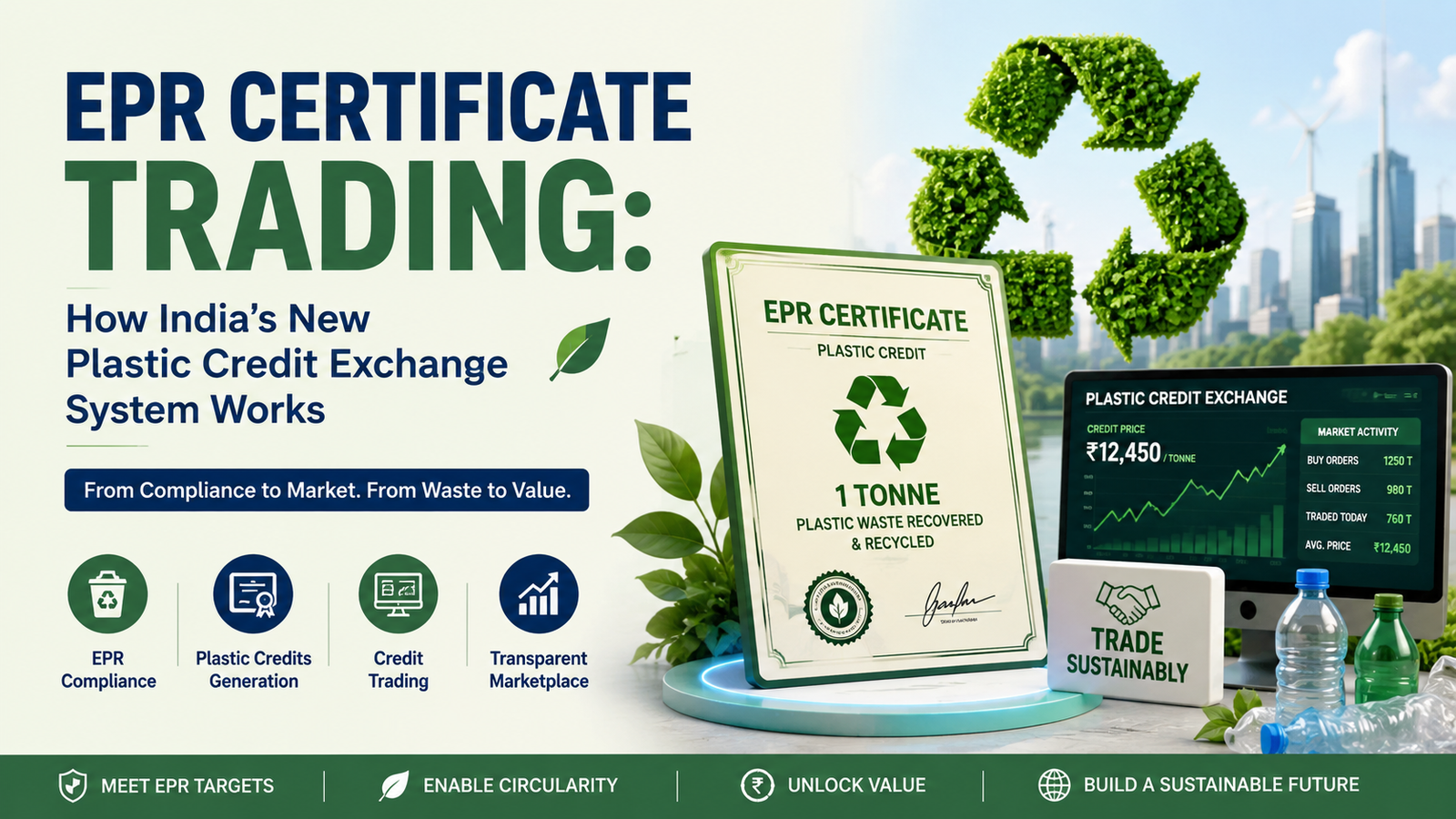
EPR Certificate Trading: How India's New Plastic Credit Exchange System Works
India’s new EPR certificate exchange is turning plastic waste compliance into a market. Here’s how certificate trading can help businesses meet targets, manage costs and support recycling.
EPR certificate trading is rapidly becoming the backbone of India's plastic waste compliance architecture. With the Central Pollution Control Board (CPCB) launching a unified electronic trading platform in February 2026 and the Plastic Waste Management (Amendment) Rules, 2026 reshaping how certificates are generated, traded, and audited, every producer, importer, and brand owner (PIBO) dealing in plastic packaging needs to understand this system — not as an abstract regulatory concept, but as a live marketplace that directly determines your compliance costs.
What Are EPR Certificates and Why Do They Exist?
Under India's Extended Producer Responsibility framework, every PIBO that places plastic packaging on the market must ensure that a defined quantity of plastic waste is collected, recycled, or processed each year. These targets are category-specific — covering rigid plastics, flexible plastics, multi-layered packaging, and other categories — and are set by the CPCB under the Plastic Waste Management Rules, 2016 (as amended).
In practice, most PIBOs do not operate their own recycling infrastructure. Instead, they rely on CPCB-registered recyclers and waste processors to handle the material. When a registered recycler processes a verified quantity of plastic waste, the CPCB portal generates an EPR certificate against that quantity. The PIBO then acquires certificates matching their obligation category and quantity to demonstrate compliance. This certificate-basedsystem creates a tradeable market — companies that over-recycle can sell surplus certificates, while those falling short can purchase them.
How the CPCB Trading Platform Works
In February 2026, the CPCB established a common portal for all seven EPR rules currently in force — covering plastic packaging, e-waste, batteries, end-of-life vehicles (ELV), tyres, used oil, and construction and demolition waste. Alongside this, a dedicated electronic platform for EPR certificate trading was launched. The common portal enables single-authentication login across all EPR verticals, eliminating the earlier friction of managing separate accounts for each waste stream.
Certificate generation follows a structured workflow. The recycler receives waste and logs procurement data on the portal. Processing is carried out using a CPCB-approved method. Once verified — increasingly through digital documentation and audit trails — the certificate is generated in the recycler's account against the confirmed quantity. PIBOs then source certificates of the matching category from the marketplace to discharge their obligation.
A critical distinction: plastic certificate pricing is entirely market-driven, with no statutory floor or ceiling price. This differs from the banded pricing structure used in e-waste and battery certificate markets. Current market rates for plastic EPR certificates range from approximately Rs 4,000 to Rs 20,000 per metric tonne, depending on the plastic category and seasonal demand.
The 2026 Amendment: What Changed
The Plastic Waste Management (Amendment) Rules, 2026, notified on 31 March 2026, introduced several significant changes to the certificate system. First, the Ministry of Environment, Forest and Climate Change (MoEF&CC) withdrew End-of-Life (EOL) provisions effective 19 January 2026, meaning that actual material recycling — where plastic is physically converted back into a usable product — is now the only pathway that counts toward primary recycling targets. Co-processing and waste-to-energy no longer qualify for primary target fulfilment.
Second, mandatory recycled content labelling under IS 14534:2023 has been introduced. Recycled content targets are phased: rigid plastics must contain 30% recycled content by 2028-29, flexible plastics 10%, and multi-layered plastics 5%. Third, the amendment introduced a carry-forward mechanism for shortfalls — companies that fail to meet their recycling targets for FY 2025-26 can carry forward the unfulfilled quantity for up to three subsequent years, provided at least one-third of the deficit is cleared annually.
Five Plastic Categories and Their Trading Dynamics
The EPR certificate market operates across distinct plastic categories, each with its own supply-demand dynamics. Category I covers rigid plastic packaging — PET bottles, HDPE containers, and similar items — which has the most liquid certificate market due to established collection and recycling infrastructure. Category II encompasses flexible plastics — pouches, wraps, and films — where recycling is technically harder and certificates tend to command higher prices.Category III multi-layered plastic (MLP) packaging is the most compliance-intensive segment. MLPs are difficult to recycle due to bonded layers of different materials, and certificate supply is constrained. Category IV covers plastic carry bags, and compostable plastics fall under separate treatment. Recycling targets vary from 30% for multi-layer packaging to 50% for rigid plastics, creating differentiated pricing pressure across categories.
Who Must Participate — And the Customs Enforcement Angle
Registration on the CPCB EPR portal is mandatory for all producers, importers, and brand owners (PIBOs) placing plastic packaging on the Indian market. The 2024 amendment expanded the definition of 'importer' to include plastic raw material importers — not just finished goods importers. This means resin importers, masterbatch suppliers, and commodity plastic traders now fall under EPR obligations.
Crucially, CPCB EPR registration has been linked to customs clearance. Importers without valid EPR registration risk having shipments held at port. The Central Board of Indirect Taxes and Customs (CBIC) has operationalised this linkage, making EPR compliance a pre-condition for clearing plastic-containing consignments. For import-dependent businesses, this transforms EPR from a periodic compliance filing into an operational necessity.
Penalties for Non-Compliance
The penalty framework under the Environment Protection Act, 1986 is substantial. Failure to obtain EPR registration attracts fines ranging from Rs 1 lakh to Rs 5 lakh, with an additional Rs 10,000 per day for continued non-compliance. Missing recycling targets can result in suspension of EPR registration — effectively halting your ability to legally place plastic packaging on the market. In serious cases, proceedings can include imprisonment.
Beyond statutory penalties, the reputational and operational risks are intensifying. The Karnataka PCB recently suspended two officials over a plastic recycling certificate scam, signalling that regulators are tightening scrutiny of fraudulent certificate generation. PIBOs that source certificates without adequate due diligence on the recycler's actual operations face the risk of their compliance being invalidated retroactively.
Practical Steps for Compliance
First, ensure your CPCB EPR portal registration is current and covers all applicable plastic categories. If you import plastic raw materials, verify that your importer registration is linked to your customs clearance process. Second, map your annual plastic packaging output by category — rigid, flexible, MLP, and others — to calculate your precise certificate requirement for FY 2026-27.
Third, establish relationships with multiple CPCB-registered recyclers rather than depending on a single source. Certificate supply can be seasonal and category-constrained. Fourth, track the carry-forward mechanism carefully — while it provides breathing room for FY 2025-26 shortfalls, the one-third annual clearance requirement means you cannot simply defer the entire deficit. Fifth, begin preparing for recycled content mandates now, since the2028-29 targets will require procurement pipeline changes that take time to implement.
What This Means for Your Business
The EPR certificate trading system is no longer a niche compliance exercise — it is a functioning market with real price signals, supply constraints, and enforcement consequences. The 2026 amendments have tightened the rules by eliminating EOL loopholes, linking EPR to customs, and introducing recycled content mandates that will reshape procurement strategies across the plastic packaging value chain.
Testa & Tegmen helps businesses navigate EPR compliance across all plastic categories — from CPCB portal registration and target calculation to certificate sourcing strategy and audit readiness. If you need clarity on your obligations or want to build a compliance roadmap for the new regulatory landscape, our advisory team is here to help.
Related service