Policy · 26 August 2026
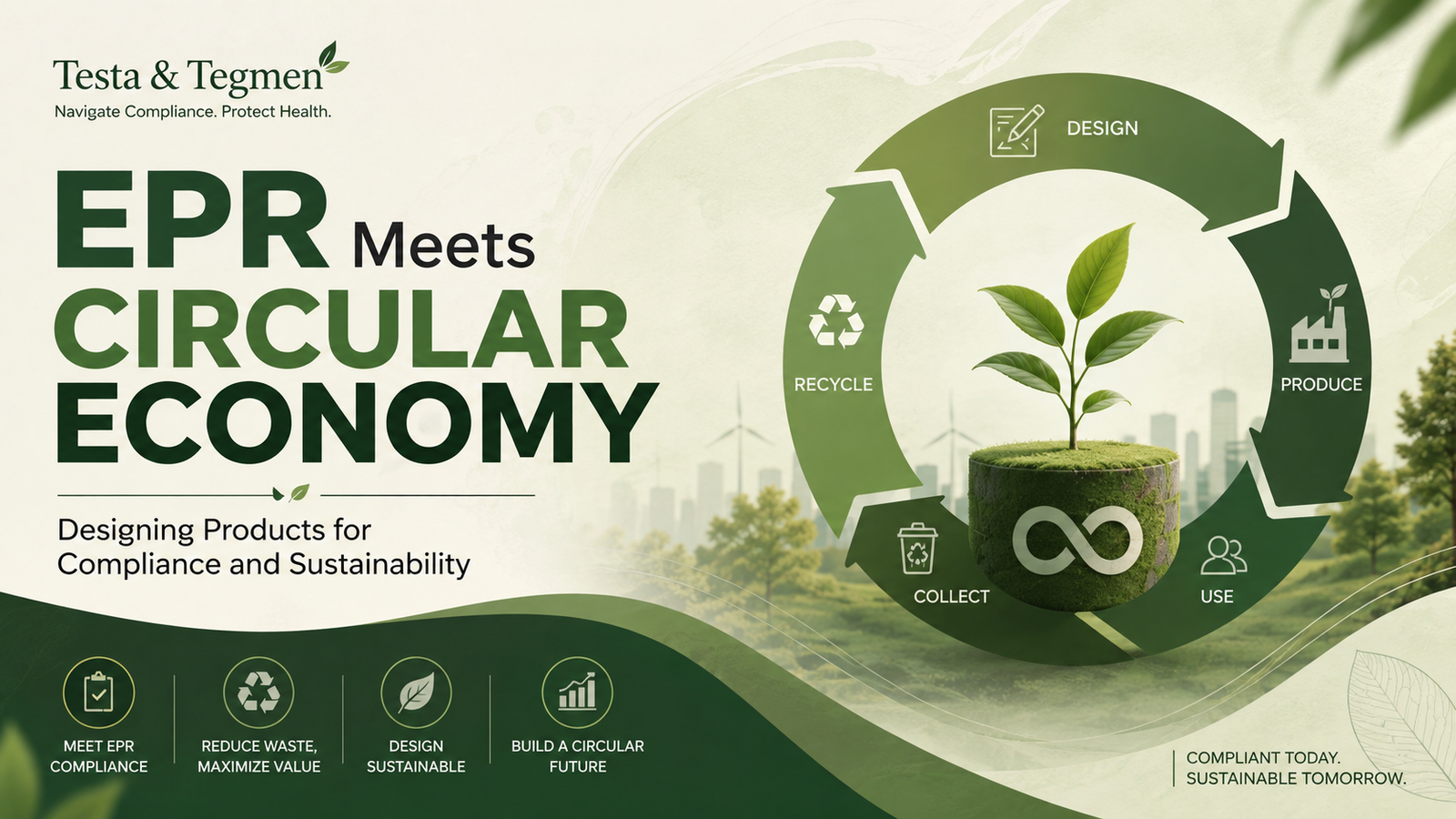
EPR Meets Circular Economy: Designing Products for Compliance and Sustainability
Explore how EPR and circular design can help businesses reduce waste, meet compliance requirements, and create sustainable products built for a resource-efficient future.
EPR compliance and circular economy design have stopped being separate conversations in India. Under the Plastic Waste Management (Amendment) Rules, 2026, your recycled content obligation is now written into the material specification of the packaging itself, not merely into an annual return you file with CPCB. The practical consequence for your business is blunt: the cheapest EPR strategy in 2026 is no longer buying certificates at year-end, it is redesigning the product so the obligation shrinks at source.
EPR in 2026: Four Regimes, One Design Question
India now operates four mature Extended Producer Responsibility regimes in parallel. Plastic packaging sits under the Plastic Waste Management Rules, 2016 as amended. Electronics fall under the E-Waste (Management) Rules, 2022. Batteries are governed by the Battery Waste Management Rules, 2022. Tyres and used oil come under the Hazardous and Other Wastes (Management and Transboundary Movement) Rules, 2016, with a dedicatedused-oil chapter inserted by Gazette notification G.S.R. 438(E) dated 1 July 2025.
Each regime has its own CPCB portal, its own certificate, its own filing calendar and its own targets. But strip away the paperwork and all four ask the same underlying question: how much of what you place on the market can realistically be recovered and put back into production?
That question is answered at the drawing board, not in the compliance department. A packaging structure chosen in a product development meeting in 2026 will determine your environmental compensation exposure in 2029.
Why your design team is now a compliance function
Most Indian PIBOs still treat EPR as a downstream reporting exercise. Procurement selects a laminate, marketing approves a label, and two years later the compliance team is buying Category III certificates at the top of the market to cover the consequences.
The regulatory design has deliberately closed that gap. Targets that escalate year on year, categories priced by recyclability, and recycled content floors that cannot be met by any certificate purchase together mean that design choices now carry a directly quantifiable compliance cost.
The Recycled Content Mandate Is a Design Mandate
MoEF&CC notified the Plastic Waste Management (Amendment) Rules, 2026 through G.S.R. 237(E) on 31 March 2026. The amendment strengthens EPR obligations and, critically, hard-codes minimum recycled content into plastic packaging by category.
For Category I rigid plastic packaging, which includes HDPE and PET containers, the requirement is 30 per cent recycled content in FY 2025-26, rising to 40 per cent in FY 2026-27, 50 per cent in FY 2027-28 and 60 per cent from FY 2028-29 onwards.
Category II flexible packaging, covering carry bags and snack wrappers, begins at 10 per cent for FY 2025-26 and FY 2026-27, then steps up to 20 per cent from FY 2027-28. Category III multi-layered plastic carries the lowest floor at 5 per cent for FY 2025-26 and FY 2026-27, rising to 10 per cent from FY 2027-28.Read those numbers carefully, because they behave differently from your recycling targets. You can meet a recycling target by procuring EPR certificates from a registered recycler. You cannot procure your way to recycled content. Recycled content is a bill-of-materials specification, verified against your own procurement records and packaging declarations.
The lead time nobody budgets for
Qualifying post-consumer recyclate into a live product is not a purchase order. It is a resin trial, a machinability check, a shelf-life and migration assessment, and for food-contact applications an additional regulatory approval pathway with its own evidentiary burden.
Businesses that start that qualification work in the quarter the target bites will miss it. Eighteen months of lead time is a realistic planning assumption for a food-contact rigid pack, and you should be scheduling backwards from FY 2027-28, not forwards from today.
Category III Is Where Design Failure Costs the Most
Multi-layered plastic is the structural problem at the centre of India's packaging circularity gap. Foil laminates, metallised films and composite cartons are engineered for barrier performance, and that same engineering makes mechanical recycling uneconomic at scale.
The rules price this reality. Category III attracts the lowest recycled content floor precisely because the recyclate supply barely exists, and Category III certificates sit at the expensive end of a plastic EPR market that broadly trades in the range of Rs 4,000 to Rs 20,000 per tonne depending on category and availability.
The circular economy answer is a mono-material transition. All-polyethylene or all-polypropylene laminates now achieve barrier properties that were unavailable five years ago, and they convert a Category III liability into a Category II one with a functioning recyclate stream behind it.
That single reclassification changes your certificate cost, your recycled content maths and your environmental compensation exposure simultaneously. Few compliance interventions do all three.
Batteries and Electronics: The Design Rules Are Already Statutory
If you make batteries or electrical and electronic equipment, design obligations are not coming. They are already in force.
The Battery Waste Management Rules, 2022 set material recovery targets of 90 per cent for electric vehicle and portable batteries by FY 2026-27, and 60 per cent for automotive and industrial batteries over the same horizon. The Second Amendment of June 2024 goes further and mandates minimum recycled material as a share of the dry weight of new batteries, beginning at 5 per cent in FY 2027-28 and scaling to 20 per cent by FY 2030-31.
A battery pack that cannot be disassembled without destroying the cells cannot hit a 90 per cent recovery figure. Adhesive-bonded modules, potted assemblies and non-standard fasteners are, in regulatory terms, design defects.
RoHS is a design constraint with a sampling regime behind it
Under the E-Waste (Management) Rules, 2022, every producer of EEE must ensure products stay within maximum permitted concentrations for lead, mercury, cadmium, hexavalent chromium, polybrominated biphenyls and polybrominated diphenyl ethers.
CPCB conducts random market sampling of equipment placed on the market to verify these reduction-of-hazardous-substances requirements. This is one of the few EPR obligations enforced by physical testing rather than portal reconciliation, which makes supplier declarations and incoming material controls a genuine risk area.
What Poor Design Actually Costs You Per Tonne
The cost of a design decision is measurable. Under CPCB guidelines dated 4 April 2024, a shortfall against your plastic EPR obligation attracts environmental compensation of Rs 5,000 per tonne in the first year, Rs 10,000 per tonne for a second consecutive year of shortfall and Rs 20,000 per tonne for a third.
Paying environmental compensation does not extinguish the obligation. The shortfall carries forward for three years, and only a portion of the payment is refundable if you subsequently meet it, on a declining scale of roughly 75 per cent in year one, 60 per cent in year two and 40 per cent in year three.
Put those two mechanisms together and the arithmetic is clear. A hard-to-recycle format does not cost you once. It compounds, at an escalating rate,across three financial years, while the target percentage against which you are measured is itself rising.
Six Design Decisions That Shrink Your EPR Liability
Move to mono-material structures wherever barrier performance permits, and reclassify Category III volumes into Category II.
Eliminate sorting defeaters. Carbon black pigments, full-body shrink sleeves and incompatible adhesives make otherwise recyclable packs invisible to near-infrared sorting lines.
Lightweight deliberately, because your obligation is calculated on weight placed on the market, and every gramme removed reduces both the target denominator and the certificate spend.
Start recyclate qualification eighteen months ahead of the target step-up, with food-contact grades prioritised first.
Design electronics and battery packs for non-destructive disassembly using standard fasteners, and document the disassembly sequence for your authorised recycler.
Evaluate reuse and refill formats, which remove tonnage from the EPR calculation entirely rather than merely making it cheaper to discharge.
Where the Regulation Is Heading
The direction of travel is consolidation and expansion. MoEF&CC has signalled work on a common EPR portal to integrate multiple waste streams and resolve the operational bottlenecks that currently force businesses to maintain separate compliance workflows for each material, a theme discussed at the ministry's conference on 4 May 2026 alongside NITI Aayog and industry.
The universe of regulated materials is widening too. A draft notification issued on 6 December 2024 proposed extending EPR to packaging made from paper, glass and metal, as well as to sanitary products, with effect from 1 April 2026. Separately, the Solid Waste Management Rules, 2026, effective 1 April 2026, embed circular economy and EPR principles into municipal waste governance.
If your current compliance model assumes plastic is the only regulated packaging material, that assumption has a short remaining life.
What This Means for Your Business
The businesses that will pay the least for EPR over the next five years are not the ones with the best certificate procurement. They are the ones whose packaging and product specifications were rewritten in 2026 to anticipate the FY 2027-28 and FY 2028-29 step-ups.
That work is cross-functional by nature. It needs a portfolio-level audit of your packaging by category, a modelled forecast of certificate and environmental compensation exposure under current design, a recyclate qualification roadmap with realistic lead times, and defensible documentation that will survive CPCB scrutiny.
Testa & Tegmen advises Indian producers, importers and brand owners on exactly this intersection of EPR compliance and circular design, from portfolio classification and target modelling through to filing readiness and audit defence. If your FY 2027-28 recycled content position is still a spreadsheet assumption rather than a qualified material, this is the year to close that gap.
Related service