Policy · 31 July 2026
From Reactive Relief to Proactive Restoration: Rethinking India's Climate Strategy
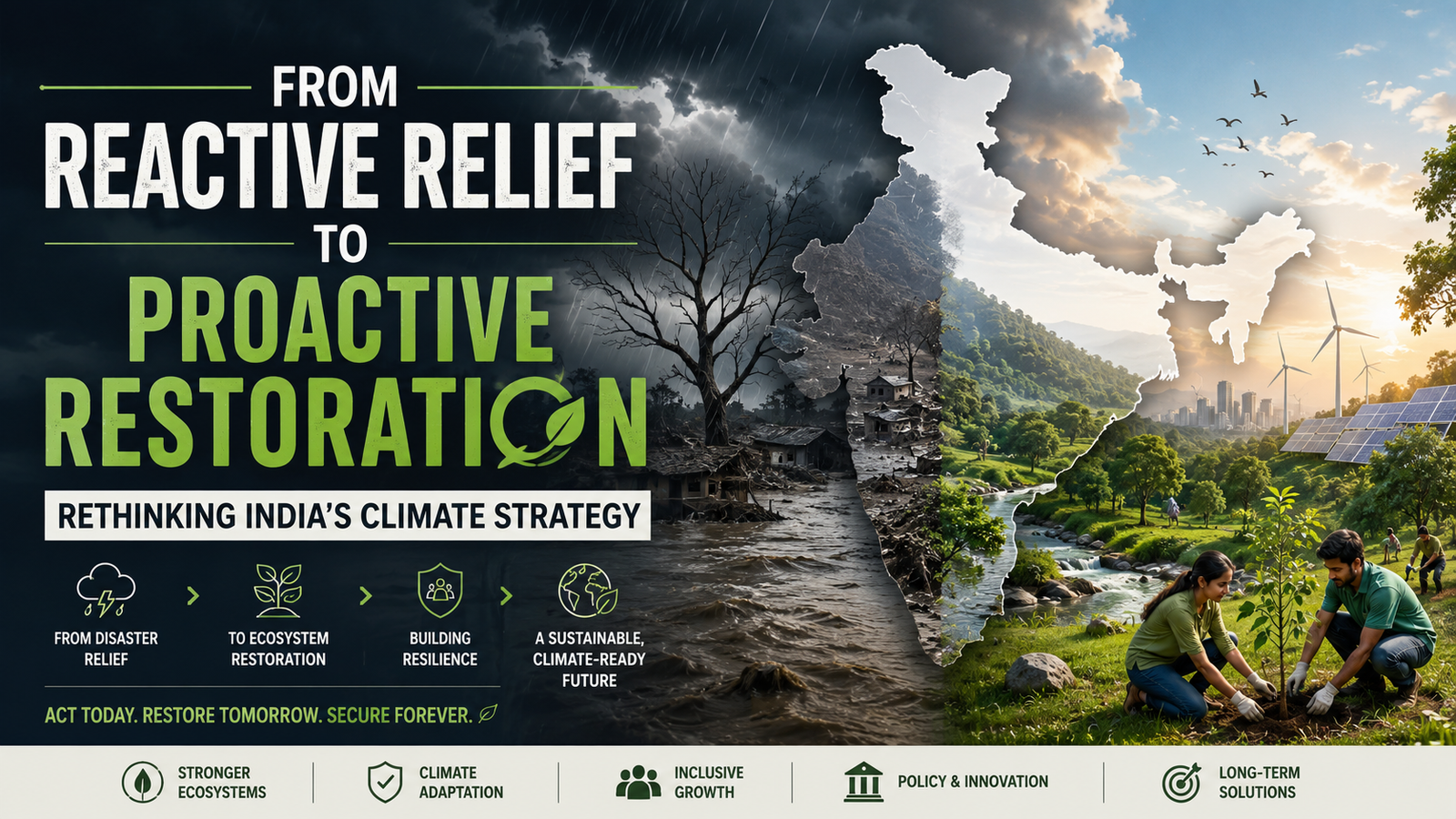
India must shift from reactive disaster relief to proactive climate restoration, investing in resilient ecosystems, adaptation, and long-term solutions to build a safer, climate-ready future.
India's climate strategy still runs on a reflex: a disaster strikes, relief cheques follow, and the country rebuilds what was lost until the next flood, cyclone or heatwave repeats the cycle. In 2025 that cycle ran almost without pause — the Centre for Science and Environment recorded extreme weather on 331 of 334 days, roughly 99% of the year. Moving from reactive relief to proactive restoration is no longer an environmental ideal; it is fast becoming the more affordable, and more defensible, way for governments and businesses to manage climate risk.
The reactive relief trap: what the 2025 numbers reveal
The scale of loss in 2025 made the limits of a relief-first model impossible to ignore. According to the CSE and Down To Earth 'Climate India 2025'assessment, extreme weather events killed at least 4,419 people over the first eleven months of the year, up from 3,006 in 2022 — and damaged crops across roughly 9.47 million hectares, with Maharashtra alone losing about 8.4 million hectares of cropped land.
The fiscal response followed the familiar pattern. Through 2025 the central government cleared emergency relief such as ₹3,100 crore for flood-hit Himachal Pradesh and Punjab and ₹1,066.8 crore for six other states, alongside reconstruction packages running into thousands of crores. Each package is necessary and humane. But taken together, they show a system that pays most heavily after the damage is done, rather than before it can occur.
Why relief-first spending no longer adds up
The economics of waiting are turning sharply against the reactive model. Analysis highlighted by Mongabay India shows that for a one-in-twenty-year event causing roughly $11 billion in losses, early resilience investment could cover the cost for about $2.2 billion, and anticipatory direct benefit transfers for about $5.4 billion — against an estimated $48.5 billion if the same losses were absorbed through existing social programmes after the fact.
Put differently, every $1 invested in early resilience is estimated to yield around $5.17 in avoided losses and development gains. When floods and cyclones alone caused an estimated $12 billion in damage in 2025, the case for spending ahead of the event rather than after it becomes a straightforward fiscal argument, not merely a green one.
Proactive restoration: the economics of resilience
Restoration is prevention, not decoration
Proactive restoration means rebuilding the natural systems that absorb shocks — reviving wetlands and floodplains that soak up excess water, stabilising slopes to prevent landslides, and restoring urban green and blue infrastructure that lowers heat and manages runoff. NDMA has already moved in this direction with its National Landslide Guidelines (2023) and Urban Flood Management Framework (2024), promoting bio-engineering for slope stabilisation and the revival of wetlands to blunt floods.
These interventions do double duty. A restored wetland reduces flood risk, sequesters carbon, supports biodiversity and can generate compliance value under emerging carbon and ESG frameworks. That is the core promise of restoration over relief: the same rupee buys risk reduction, ecological recovery and a measurable asset, instead of only replacing what was destroyed.
Where India's policy architecture already points forward
India is not starting from zero. The 15th Finance Commission (2021–26) allocated around ₹2.28 lakh crore to strengthen disaster risk reduction, with a large share flowing to states specifically for preparedness and adaptivecapacity rather than post-event relief. On the global stage, India's Coalition for Disaster Resilient Infrastructure (CDRI) now brings together more than 40 countries to mainstream resilience into how infrastructure is planned and built.
The direction of travel in national planning is clear: resilience is increasingly being written into the design stage of roads, buildings and utilities, where it is cheapest to add, rather than retrofitted after a disaster exposes the weakness. For Indian businesses, this signals where regulation, procurement standards and financing conditions are heading.
Gaps that keep India reactive
The shift is real but incomplete. A key structural gap is the absence of a formal finance mechanism linking disaster relief to social protection, which limits how quickly and predictably support reaches vulnerable communities. Definitional gaps compound the problem: heatwaves are still not notified as a 'disaster' in several states, so dedicated disaster funds cannot easily be tapped for extreme-heat damage even as heat becomes one of India's deadliest hazards.
Changes to the Manual for Drought Management have also made it harder for jurisdictions to formally declare drought, delaying the relief and restoration funding that a declaration unlocks. Closing these gaps — recognising new hazards, funding prevention as a line item, and rewarding restoration — is what will convert stated intent into a genuinely proactive system.
Nature-based solutions as climate strategy
For a country as ecologically diverse as India, nature-based solutions are among the most cost-effective routes to resilience. Restoring mangroves along the coast buffers storm surge and protects fisheries; reviving urban lakes and wetlands cuts flood peaks and cools cities; regenerating catchments and forests steadies water supply and reduces landslide risk. These are climate mitigation and adaptation measures at once, and they are increasingly bankable through carbon and biodiversity credit pathways.
What this means for your business
If your operations, real estate or supply chains sit in flood-prone, heat-stressed or landslide-exposed areas, the reactive model is becoming a balance-sheet liability. Regulators, lenders and insurers are already beginning to price physical climate risk, and BRSR and ESG disclosures increasingly ask how you manage it. Building restoration and resilience into your sites now — rather than claiming relief later — protects continuity, lowers long-term cost and strengthens your compliance position.
Testa & Tegmen advises businesses on exactly this transition: assessing physical climate and regulatory exposure, embedding resilience and nature-based measures into projects and EC compliance, and turning restoration into a documented, disclosure-ready asset. If you want to move yourorganisation from reacting to disasters toward preventing them, our advisory team can help you build a proactive climate strategy that stands up to scrutiny and pays for itself over time .
Related service