Policy · 23 September 2026
Construction and Demolition Waste: Recycling Mandates and Compliance for Developers
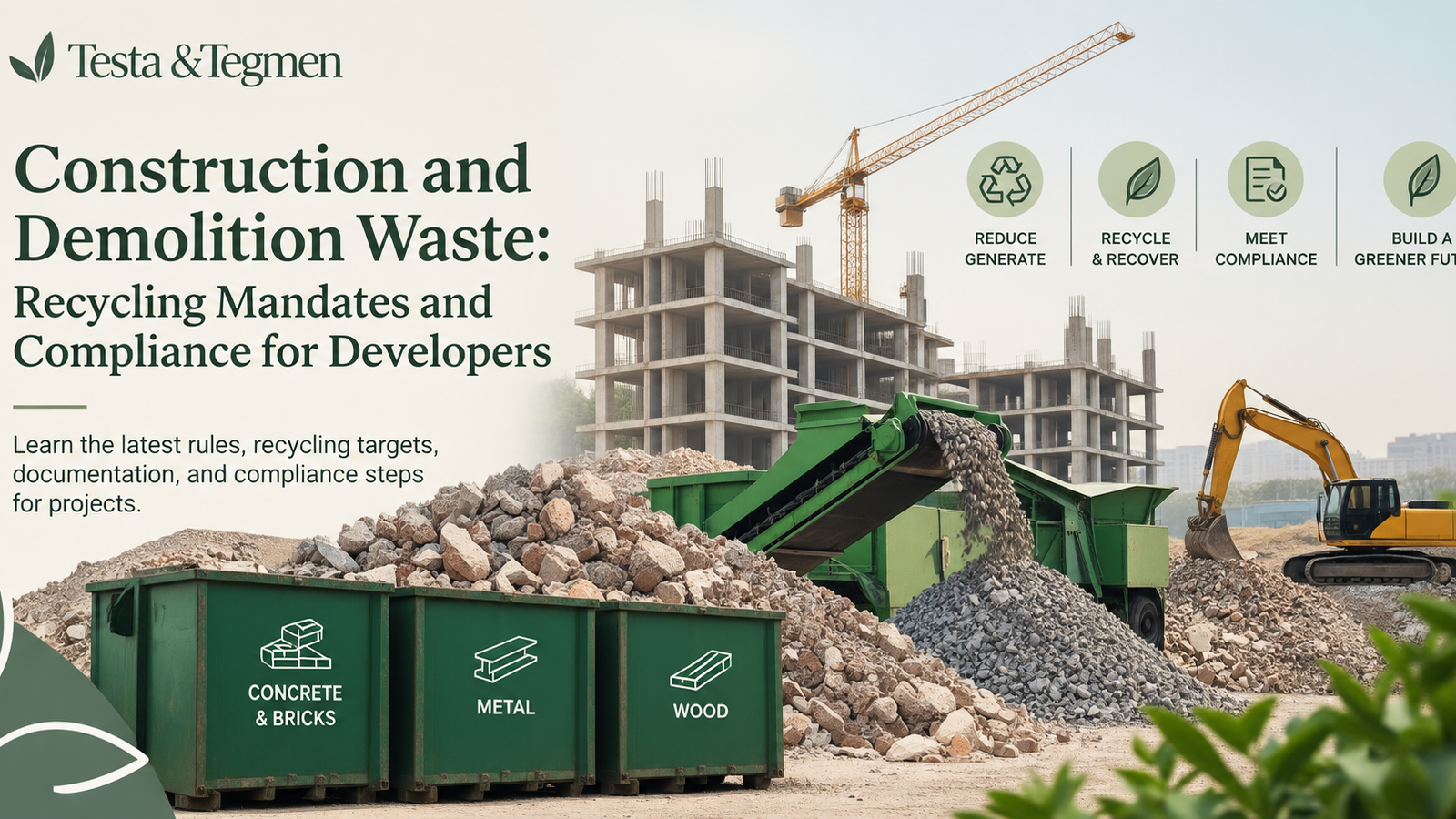
Construction and Demolition Waste: Recycling Mandates and Compliance for Developers. Learn the latest rules, recycling targets, documentation, and compliance steps for projects.
Construction and demolition waste is now one of the fastest-growing regulatory risks for Indian developers. With the Environment (Construction and Demolition) Waste Management Rules, 2025 taking effect from 1 April 2026, every project with a built-up area of 20,000 square metres or more is legally accountable for what happens to its rubble, concrete, steel, and site debris. If your firm is still treating C&D waste as a haulage line item, this piece is your compliance wake-up call.
What the C&D Waste Rules 2025 Actually Change
The Ministry of Environment, Forest and Climate Change (MoEFCC) notified the new Rules in April 2025, replacing the earlier 2016 framework. For the first time in India, Extended Producer Responsibility (EPR) has been formally embedded into construction waste law, putting India ahead of most major economies on paper.
The core shift is philosophical: developers are no longer just "generators" who dispose of waste, they are "producers" who must ensure it is recycled and reintroduced into the value chain. The Central Pollution Control Board (CPCB) has been designated the implementing authority, and a Central Steering Committee chaired by the CPCB Chairperson, with representation from NITI Aayog, BIS, and line ministries, oversees rollout.
Who Counts as a Bulk Generator
You are a bulk generator, and therefore a producer under EPR, if your project has a built-up area equal to or greater than 20,000 square metres. This threshold captures group housing, IT parks, malls, hospitals, hotels, and most mid-to-large mixed-use developments across NCR, MMR, and Bengaluru urban agglomerations.Contractors executing demolition or reconstruction on such projects share compliance responsibility with the principal developer. Sub-20,000 sqm projects are still subject to municipal C&D bye-laws and the general polluter-pays principle, but the EPR machinery does not apply.
EPR Recycling Targets: The Numbers You Cannot Ignore
The Rules prescribe two distinct target ladders, and developers are expected to meet both:
EPR recycling target on waste generated: 25 per cent in FY 2025-26, rising annually to 100 per cent from FY 2028-29 onwards.
Utilisation (recycled content) target in new construction: 5 per cent in FY 2026-27, rising to 25 per cent by FY 2030-31 for buildings, and 15 per cent for road projects.
The recycling obligation is met by procuring EPR certificates from CPCB-registered recyclers equivalent to your notified target quantity. The utilisation obligation must be demonstrated in project bills of quantities using processed C&D aggregate conforming to IS 383 and other relevant BIS standards.
The CPCB Digital Portal and Registration
Every producer, recycler, and processor must register on the CPCB C&D EPR portal before the effective date. Registration requires project details, estimated waste generation over the project lifecycle, a site-specific Waste Management Plan, and undertakings on segregation at source. Recyclers upload their processing capacity and the EPR certificates they intend to issue.
Once registered, producers file half-yearly returns disclosing waste generated, waste sent to registered recyclers, EPR certificates procured, and recycled content used. The portal will operate on the same central architecture that CPCB has deployed for plastic and e-waste EPR, meaning your compliance data becomes traceable, auditable, and cross-linkable to your Environmental Clearance filings.
What Your Waste Management Plan Must Contain
A defensible Waste Management Plan is your most important pre-construction document under the new regime. It should quantify expected debris by material stream (concrete, brick, steel, wood, glass, gypsum, mixed inerts), name the CPCB-registered recycler you will consign to, detail on-site segregation infrastructure, and map internal haulage routes to prevent fugitive dust and unauthorised dumping.
Weak plans, boilerplate copy-pastes across sister projects, or vague commitments to "responsible disposal" are exactly the kind of language that gets Environmental Clearance compliance reports returned for rectification by SEIAA and State Pollution Control Boards.
Penalties and Enforcement Risk
Non-compliance with the C&D Rules attracts action under Sections 15 to 17 of the Environment (Protection) Act, 1986, which carry imprisonment up to five years, fines up to one lakh rupees, and daily continuing-offence penalties. In parallel, environmental compensation is levied through CPCB and SPCB orders, and Real Estate (Regulation and Development) Act, 2016 authorities in several states are beginning to link project registration renewals to environmental compliance status.
For NCR developers, add the Commission for Air Quality Management (CAQM) into the picture: illegal C&D dumping and inadequate dust control are already GRAP triggers, and CAQM has escalated enforcement year on year.
Practical Steps to Take Before April 2026
Audit every ongoing and pipeline project against the 20,000 sqm threshold and flag which entities in your group become "producers".
Identify and shortlist two or three CPCB-authorised recyclers in each operating city and lock in commercial terms early — recycling capacity is limited and pricing will tighten.
Redesign your project procurement templates so that BOQs specify recycled aggregate percentages in line with the utilisation ladder.
Update your EC six-monthly compliance report templates to include C&D EPR certificate numbers, quantities, and recycler details.
Train site engineers and safety officers on segregation at source — mixed waste is not accepted at most processing facilities and carries a cost penalty.
What This Means for Your Business
The C&D Rules 2025 are not a paperwork exercise. They are a full-stack shift in how urban India is expected to build, and they arrive alongside CCTS, expanded EPR regimes, and tightening EC scrutiny. Developers that treat compliance as a design input, not a downstream cost, will finish projects on time, avoid show-cause notices, and unlock green-finance premiums.
At Testa & Tegmen, we help developers, contractors, and industrial clients map their C&D exposure, register on the CPCB portal, build defensible Waste Management Plans, and integrate EPR compliance into their existing Environmental Clearance workflows. If you have a project crossing the 20,000 sqm mark before April 2026, now is the moment to plan.
Related service