Policy · 16 June 2026
Delhi Air Pollution: Causes, Solutions and Why Urgent Action Cannot Wait
Delhi air pollution remains a major public health crisis driven by vehicles, industry, waste burning and seasonal factors. This article explains the causes and outlines practical solutions.
Introduction
Delhi air pollution has become a recurring public-health and governance crisis. Every winter, pollution levels rise, schools close, construction activities are restricted and emergency measures are introduced. Once conditions improve, attention declines until the crisis returns.
The problem is serious, but it is not impossible to solve. Delhi’s geography and winter weather intensify pollution, yet similar conditions have been addressed elsewhere. Beijing faced a comparable combination of industrial emissions, traffic pollution, agricultural burning, coal use and unfavourable geography. Its experience shows that air quality can improve when governments adopt measurable targets, provide cleaner alternatives and enforce environmental rules consistently.
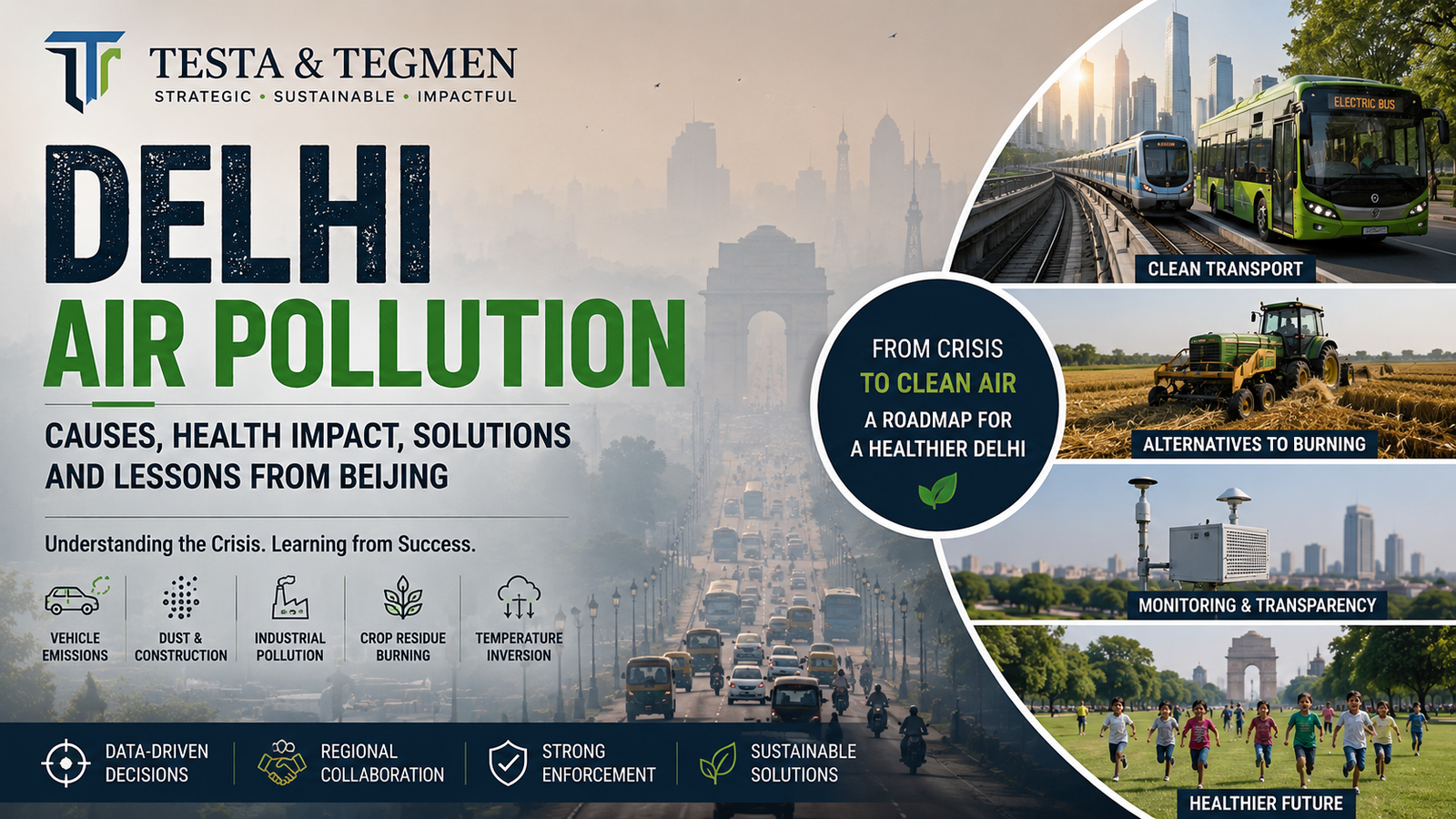
Delhi air pollution is caused by a combination of vehicle emissions, road dust, construction activity, industrial pollution, fuel combustion and seasonal crop-residue burning. Winter temperature inversions and Delhi’s geographical setting trap these pollutants close to the ground, causing concentrations to rise sharply. No single source is responsible throughout the year; the contribution of each source changes with the season, location, weather and research method used.
Why Delhi Air Pollution Becomes Severe in Winter
Delhi’s winter smog is produced by the interaction of emissions, geography and weather. Pollutants released within the city and transported from surrounding regions can remain close to the surface when atmospheric circulation is weak.
Delhi’s Geographical Bowl Effect
Delhi lies within a region influenced by major geographical formations. The Himalayas are located to the north, while the Aravalli range lies towards the south and west. Under certain weather conditions, these features can restrict the movement and dispersal of polluted air. This effect is often described as a geographical bowl.
Local emissions and pollution transported from nearby regions may accumulate rather than disperse. The resulting mixture includes PM2.5, PM10, nitrogen oxides, sulphur dioxide, ground-level ozone and carbon monoxide.
Why PM2.5 Is a Major Health Concern
PM2.5 refers to particulate matter with a diameter of 2.5 micrometres or less. These particles are far smaller than the width of a human hair. Because of their size, they can travel deep into the respiratory system and may enter the bloodstream, making PM2.5 one of the most significant components of Delhi’s air-pollution problem.
Temperature Inversion and Delhi Winter Smog
Under normal conditions, the ground warms the air immediately above it. This warmer air rises and helps carry pollutants away from the surface. During winter nights, however, the ground cools quickly. The air near the ground can become colder than the layer above it, and the warmer upper layer acts like a lid that prevents vertical air movement.
This phenomenon is known as a temperature inversion. The transcript states that Delhi’s atmospheric mixing height may fall from approximately 1,000 metres in summer to about 100 metres in winter. When pollutants are trapped within a smaller volume of air, their concentrations can increase even if the quantity being emitted remains similar. Seasonal winds may further worsen Delhi air quality by transporting smoke, dust and industrial pollution into the National Capital Region.
Major Causes of Delhi Air Pollution
Delhi’s polluted air results from several local and regional sources, so control measures must address multiple sectors.
Vehicle Pollution and Road Dust
The transcript reports that Delhi has approximately 12 million registered vehicles. Vehicles contribute through exhaust emissions and by resuspending dust that has already settled on roads.
The transcript claims that a vehicle may resuspend approximately 10 to 15 grams of road dust per kilometre. Temporary traffic restrictions may offer limited relief, but lasting improvement depends on cleaner, accessible public transport.
Road dust is repeatedly identified as a major contributor, although estimates vary. Traffic, wind and road activity can make settled dust airborne again, so lasting control requires prevention and cleaner road surfaces rather than occasional sprinkling.
Construction and Demolition Dust
Construction activity is another major source of particulate matter. Excavation, demolition, uncovered building materials, debris handling and the movement of heavy vehicles can release significant quantities of dust.
The transcript states that Delhi generates more than 6,850 metric tonnes of construction and demolition waste each day. Construction sites are generally expected to use dust screens or green barriers, water spraying, covered storage and covered vehicles for transporting debris. However, the transcript claims that compliance with these requirements is below 30 per cent.The deeper problem is inconsistent enforcement.
Industrial and Regional Pollution
Industrial emissions from areas surrounding Delhi can contribute to the city’s pollution when winds transport them into the region. The transcript specifically refers to industrial pollution from areas such as Panipat and Sonipat. Because air pollution does not stop at administrative borders, Delhi cannot solve the crisis through city-level measures alone. A regional pollution-control strategy is necessary.
Stubble Burning and Seasonal Pollution
Crop-residue burning is one of the most debated causes of Delhi winter smog. Farmers in Punjab and Haryana often have only a short interval between harvesting paddy and preparing fields for the next crop. The transcript links this narrow agricultural window to groundwater-conservation policies that delayed crop planting.
With limited time and insufficient access to affordable alternatives, burning residue can become the quickest and least expensive option. The transcript claims that approximately 35 million tonnes of paddy straw are burned and that stubble burning may contribute up to 40 per cent of Delhi’s PM2.5 on peak burning days. This peak contribution should not be confused with the annual share of pollution, because vehicles, road dust, construction activity and industrial emissions operate over longer periods.
Punishment alone is unlikely to eliminate agricultural burning if farmers do not have practical alternatives. Effective measures may include access to residue-management machinery, markets for agricultural residue, biomass-processing infrastructure and timely financial support. The core policy lesson is that polluting behaviour becomes easier to control when cleaner choices are practical and economically attractive.
Why Delhi Pollution Studies Give Different Answers
One of the biggest challenges in controlling Delhi air pollution is disagreement over the relative contribution of different sources. The transcript refers to studies that estimate vehicle pollution and road-dust contributions at substantially different levels.
These differences may result from different sampling periods, monitoring locations, atmospheric models, emission factors, seasonal conditions and study boundaries. Scientific variation is expected because sources change over time, but uncertainty should not become an excuse for inaction.
Industries may blame vehicles, automobile interests may blame road dust, and governments may emphasise stubble burning while neighbouring states focus on Delhi’s local emissions. A serious clean-air strategy does not require every study to produce exactly the same answer. It requires transparent methods, regularly updated emissions inventories and a shared evidence base that cannot be selectively used to shift blame.
Why Emergency Measures Do Not Solve Delhi Air Pollution
Delhi frequently relies on the Graded Response Action Plan when air quality reaches severe levels. Measures may include construction restrictions, school closures, traffic controls, water sprinkling and temporary limits on certain polluting activities.
These steps may reduce immediate exposure, but they are largely reactive. Water sprinkling can temporarily prevent loose dust from becoming airborne, yet it does not remove the underlying source. Similarly, closing schools may reduce children’s outdoor exposure for a limited period, but it does not make the surrounding air safe.
Emergency measures must therefore be supported by year-round pollution prevention. Without structural reform, Delhi moves repeatedly between winter crisis management and reduced attention during the rest of the year.
India’s Clean-Air Funding and Implementation Gap
India launched the National Clean Air Programme in 2019. The transcript states that ₹19,711 crore was allocated and that approximately 57 per cent had been utilised by 2024.It further claims that around 64 per cent of expenditure went towards dust control, 15 per cent towards biomass burning, 13 per cent towards vehicular pollution and 0.61 per cent towards industrial pollution.
The central concern is whether spending produces measurable pollution reductions. A successful programme should focus on verified emission reductions, better construction-site compliance, cleaner industrial operations, expanded public transport, reduced agricultural burning, improved monitoring and transparent enforcement records. The number of machines purchased or roads sprinkled is less important than whether long-term PM2.5 exposure declines.
Delhi Air Pollution Is Also an Inequality Issue
Air pollution affects the entire city, but exposure and protection are not distributed equally. Higher-income households may use air purifiers, cars with cabin filters, filtered offices and protected school environments. These measures can reduce, but not eliminate, exposure.
Outdoor workers have far fewer options. Rickshaw drivers, street vendors, construction workers, traffic personnel, security guards and sanitation workers may spend long hours breathing polluted outdoor air. This creates a health divide in which cleaner air becomes something that can be purchased rather than a public good available to everyone.
The transcript claims that a child born in Delhi may lose eight to ten years of life expectancy because of air pollution.Even where the exact estimate requires confirmation, the underlying concern remains: people with the least ability to avoid polluted air may face the greatest exposure.
How Public Accountability Can Improve Air Quality
The transcript argues that Beijing’s progress should not be explained only by China’s political system. It refers to research in which Chinese municipal governments were publicly rated on environmental transparency. Public access to pollution information reportedly enabled citizens to identify high-polluting companies and apply pressure.
The transcript claims that this process contributed to a 37 per cent reduction in violations by affected companies and an 8 to 10 per cent reduction in ambient air pollution.It also refers to community environmental action in Plachimada, Kerala; clean-heating reform in New York; and organising around Indonesia’s Citarum River. These outcomes require verification, but the examples show how transparent data can focus pressure on identifiable polluters and responsible authorities.
What Delhi Must Do to Reduce Air Pollution
Delhi does not need another short-term winter campaign. It needs a long-term regional clean-air strategy with defined responsibilities and measurable results.
First, different source-apportionment studies should be made easier to compare through transparent methods and regularly updated emissions inventories. Perfect agreement is unnecessary, but decision-makers need a shared evidence base.
Second, Delhi should establish measurable targets for transport, road dust, construction, industrial activity, household fuel use and agricultural burning. Progress should be judged through verified emission reductions, not announcements.
Third, cleaner alternatives must be affordable and available. Farmers, households, commuters and small businesses are more likely to change polluting practices when practical alternatives exist.
Fourth, existing pollution-control rules must be enforced consistently. Construction barriers, covered transport and industrial standards have limited value if violations do not lead to timely consequences.
Finally, citizens should be able to see how clean-air funds are spent, which agencies are responsible, which sites have violated rules, what enforcement action has been taken and whether pollution levels are improving. Public access to this information can strengthen institutional accountability.
Key Takeaways
Delhi air pollution is caused by several local and regional sources, including vehicles, road dust, construction, industry and crop-residue burning.
Winter temperature inversions trap pollution close to the ground and intensify Delhi winter smog.
Stubble burning can be significant during peak periods, but it is not the city’s only pollution source.
Emergency measures cannot replace year-round emission reduction.
Beijing improved air quality through measurable targets, cleaner alternatives, investment and enforcement.
Transparent data and institutional accountability are essential to lasting reform.
Conclusion
Delhi air pollution is not beyond human control. Its major sources are broadly understood, and the types of interventions required are already known. The deeper challenge lies in coordination, enforcement, sustained investment and accountability.
Beijing does not provide a perfect policy template for Delhi. However, its experience shows that difficult geography and severe pollution do not make recovery impossible. Delhi must move from seasonal reaction to year-round prevention, from fragmented action to a regional strategy, and from temporary suppression to structural reform.
The decisive question is whether institutions will act consistently enough to produce lasting improvement.
Frequently Asked Questions
What are the main causes of Delhi air pollution?
The main causes include vehicle emissions, road dust, construction and demolition activity, industrial pollution, fuel combustion and seasonal crop-residue burning. Weather and geography determine how strongly these pollutants accumulate.
Why is Delhi air pollution worse in winter?
Winter temperature inversions trap polluted air near the ground. Lower mixing heights and weaker atmospheric circulation reduce the ability of pollutants to disperse.
Is stubble burning the main cause of Delhi pollution?
Stubble burning can contribute significantly during peak autumn periods, but it is not Delhi’s only source. Vehicles, dust, construction and industrial emissions contribute over longer periods.
What is PM2.5?
PM2.5 refers to airborne particles with a diameter of 2.5 micrometres or less. Their small size allows them to travel deep into the lungs and potentially enter the bloodstream.
Do water sprinkling and construction bans solve Delhi pollution?
They may provide temporary relief during severe episodes, but they do not remove the underlying sources. Long-term improvement requires continuous emission reduction.
How did Beijing reduce air pollution?
Beijing closed or relocated major polluters, replaced household coal use, expanded public transport, provided alternatives to agricultural burning and enforced environmental targets.
What is the most effective long-term solution?
There is no single solution. Delhi requires coordinated action on transport, road dust, construction, industry and crop-residue burning, supported by transparent monitoring and enforcement