Compliance
Compliance in NCR in Uttar Pradesh during GRAP explained
A practical guide to UP NCR C&D waste Management and dust pollution control. Plot and construction area, Web-monitoring records, anti-smog guns, PTZ Camera, CC/OC checks, and recent GRAP notifications explained.
Contents
- Introduction
- How GRAP implementation affects work at a construction site
- Role of CAQM during GRAP and its Directions
- Web-monitoring requirements of Construction Site
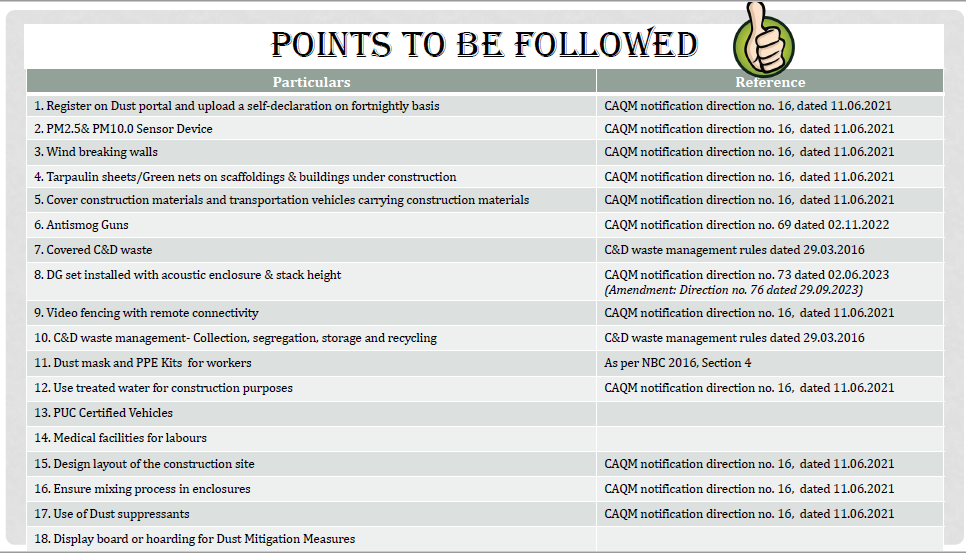
- Dust mitigation and control measures at construction sites
- Anti-smog guns and the correct area measurement
- Issuance of Completion certificate (CC) or Occupancy Certificate (OC)
- A practical review before the next work shift
- Frequently asked questions
- Does a plot of exactly 500 m² meet the portal threshold?
- Does the same portal rule automatically cover all of Uttar Pradesh?
- Are anti-smog guns calculated using plot area?
- Does registration prove that my site complies?
- Does Direction 51 establish a permanent construction ban?
- Does a general GRAP relaxation allow an individually closed site to restart?
- Does the 500 m² portal threshold replace the 200 m² demolition test?
Key takeaways
Who this is for: UP NCR project proponents, developers, site engineers, architects, contractors and environmental professionals
- The Construction and Demolition Waste Management Rules 2025 came into effect from 1st April 2026 and apply to all activities of construction, demolition, remodelling,renovation and repair of any structure
- For demolition/reconstruction on plots of 200 sq. m or more, debris must go to designated facilities, and a disposal receipt is required before obtaining an Occupancy or Completion Certificate
- Under CAQM Direction No. 97, plots of 500 sq. m or more in NCR require UPPCB portal registration, self-audits, and installation of live PM2.5/PM10 sensors.
Introduction
Following the implementation of GRAP Stage I in NCR, proponents of building and construction projects in the Uttar Pradesh areas of the National Capital Region (NCR)—Meerut, Ghaziabad, Gautam Budh Nagar (Noida), Bulandshahr, Baghpat, Hapur, Shamli and Muzaffarnagar—need to understand how the next 3–4 months of GRAP restrictions will affect construction work and timely project completion.
How GRAP implementation affects work at a construction site
Project proponents who decide to undertake construction activities this winter will therefore need to align their sites with the applicable CAQM directions and UPPCB regulations. The 2026 GRAP schedule issued with Direction 104 on 29 September 2026 is a separate part of the assessment. Stage I includes enforcement of construction-dust measures and restrictions on covered projects with a plot area of at least 500 m² that are unregistered or otherwise non-compliant with Directions 11–18.
Project proponents must therefore consider three questions in their daily decisions:
- which continuing controls apply to the site under the GRAP stage in effect;
- whether all dust-mitigation protocols are being followed, even when no one is monitoring the site; and
- whether the site has received a show-cause notice or is subject to any other specific restriction.
Role of CAQM during GRAP and its Directions
The framework of the Commission for Air Quality Management in NCR and Adjoining Areas (CAQM) for dust control at construction and demolition (C&D) sites combines dust-control directions, web-based monitoring, surprise inspections and restrictions on construction activities through the invocation of Graded Response Action Plan (GRAP) stages. CAQM recently invoked Stage I of GRAP across NCR through the 21 October order.
CAQM Direction 13, dated 11 June 2021, established the monitoring framework for construction and demolition projects in Uttar Pradesh’s NCR areas. The CAQM directions apply to plot areas of 500 square metres or more. In addition to dust portal registration, the installation of web-monitoring devices, such as PTZ cameras and PM sensors, was made mandatory for these projects.
On 29 September 2026, CAQM extended the existing framework beyond municipal coverage to eligible projects in specified NCR urban, controlled, development, industrial-development, industrial and highway-corridor areas recognised under the relevant laws or planning frameworks. This September 2026 amendment also retains the 500 m² plot threshold and the other provisions of the earlier directions.
Web-monitoring requirements of Construction Site
Direction 13 calls for site self-monitoring through remotely connected video monitoring (PTZ Camera), reliable low-cost PM2.5 and PM10 sensors. These installation enable the Pollution Board (UPPCB) to monitor construction sites remotely. Projects must also submit a fortnightly self-assessment audit sheet on the UPPCB dust portal. Every project owner must ensure compliance with these requirements, whether or not construction is underway.
The site representative or person submitting the dust audit may not supervise every part of the project site. It is therefore important to establish an internal monitoring system. Retain relevant acknowledgements, supporting evidence and logbooks documenting dust-mitigation activities, including anti-smog gun use and C&D waste disposal, so that the proponent can demonstrate compliance if a show-cause notice is issued.
Dust mitigation and control measures at construction sites
An invoice for dust-mitigation or monitoring equipment, such as an ASG or PM sensor, and its operating records or logbooks serve different purposes. The invoice can show procurement; operating records help explain how the equipment is used. Supporting records should therefore include geotagged photographs of the equipment, regular operating checks, maintenance entries and actions taken when controls fail.
These records should demonstrate the actual control arrangements at the site rather than simply increase the collection of unrelated photographs.:
- Using ASGs and sprinklers for wet suppression during activities such as mixing, cutting and grinding, and in areas with dust-generation potential, such as unpaved surfaces and excavated earth.
- Managing approach roads.
- Covering construction materials and C&D debris during storage and transport.
- Cleaning the tyres and underbodies of vehicles leaving the site.
Anti-smog guns and the correct area measurement
Direction 69 uses total construction area, which is distinct from Direction 13’s plot-area test. Construction area means the area of the project on which construction is being carried out. Functional anti-smog guns (ASGs) are required according to the following construction-area bands:
- 5,000–10,000 m²: at least one anti-smog gun.
- 10,001–15,000 m²: at least two.
- 15,001–20,000 m²: at least three.
- Above 20,000 m²: at least four.
Issuance of Completion certificate (CC) or Occupancy Certificate (OC)
CAQM's Direction 79 directs the responsible agencies not to issue a Completion Certificate (CC) or Occupancy Certificate (OC) for a project against which a CAQM closure direction is pending. It also refers agencies to information about entities whose resumption orders have not been issued. A generally relaxed pollution-control stage should therefore not be assumed to lift an individual project’s closure.
CAQM's Direction 97 addresses another evidence sequence. Within its specified scope of major NCR cities with municipal corporations, including the New Delhi Municipal Council (NDMC), and/or development authorities, its relevant clauses concern plots of at least 200 m² where demolition is required before construction or reconstruction. They provide for an estimated demolition-quantity declaration before building-plan approval, deposition and a receipt before construction or reconstruction, and receipt verification before CC/OC issuance.
These requirements should be tracked separately. Portal registration does not establish that a pending closure has been resolved. A demolition receipt does not establish compliance with every dust-control condition. Our Direction 97 explainer examines that declaration-and-receipt sequence in greater detail.
A practical review before the next work shift
The following is an editorial preparation sequence, not an additional statutory form or a prescribed filing deadline:
Confirm the project facts. Record the plot measurement, construction-area calculation, location and relevant planning authority. Resolve inconsistent measurements before applying thresholds.
Review the current directions. Keep the underlying CAQM instruments, September amendments, latest GRAP order and any individual notices accessible to the people deciding what work proceeds.
Connect records with operations. Compare declarations, camera and sensor arrangements, equipment deployment and physical controls with the activities planned for the shift.
Resolve outstanding restrictions. Escalate a pending closure, missing evidence of receipt or an unresolved authority query to the responsible decision-maker rather than assuming that another approval resolves it.
Document corrections and handover. Identify the issue, the person assigned, the action taken and the supporting evidence. .
Frequently asked questions
Does a plot of exactly 500 m² meet the portal threshold?
Yes. The original direction uses an inclusive threshold of 500 m² or more, retained by the September amendment. The project must also fall within the relevant geographical and other conditions. The numerical test should not be rewritten as strictly above 500 m².
Does the same portal rule automatically cover all of Uttar Pradesh?
These CAQM instruments concern the relevant NCR framework. Their numbers should not be transferred automatically to every Uttar Pradesh location. Check separately applicable UPPCB, local-authority and project-specific requirements. A project outside municipal limits still needs the September amendment’s planning-area assessment.
Are anti-smog guns calculated using plot area?
No. Direction 69 uses total construction area for its stated bands. Direction 13’s portal test uses plot area. Keep both measurements and their supporting calculations identifiable. A project’s description as small or large is not a substitute for the measurement the particular instrument requires.
Does registration prove that my site complies?
No. Registration, periodic declarations, monitoring arrangements and physical controls address different requirements. The GRAP schedule also addresses covered projects that are otherwise non-compliant. Review the operating conditions and supporting records rather than relying solely on the registration acknowledgement.
Does Direction 51 establish a permanent construction ban?
Its December 2021 position was subsequently reviewed by Direction 52. Determine a present work restriction from the applicable later instruments and latest orders. Historical exemption categories should not be copied as a definitive current permission list.
Does a general GRAP relaxation allow an individually closed site to restart?
Do not assume so. Examine the specific closure and the required resumption position. Direction 79 separately addresses CC/OC issuance while CAQM closure is pending. General area-wide measures and an individual project’s restrictions need separate checks.
Does the 500 m² portal threshold replace the 200 m² demolition test?
No. Direction 97 has its own geographical and demolition-related conditions. A project can require examination under that framework even if it does not meet the portal’s numerical threshold. A deposition receipt also does not replace other permissions or establish complete environmental compliance.
Sources & further reading
- CAQM Direction 13: UP NCR construction-dust web monitoring
- CAQM Direction 69: anti-smog guns at C&D projects
- CAQM Direction 79: pending closure and CC/OC issuance
- CAQM Direction 97: demolition declarations and receipts
- CAQM amendment to Directions11–18: geographic extension
- CAQM Direction104 and revised GRAP schedule
- MoEFCC review of Uttar Pradesh winter action plan and construction-site monitoring