Policy · 01 September 2026
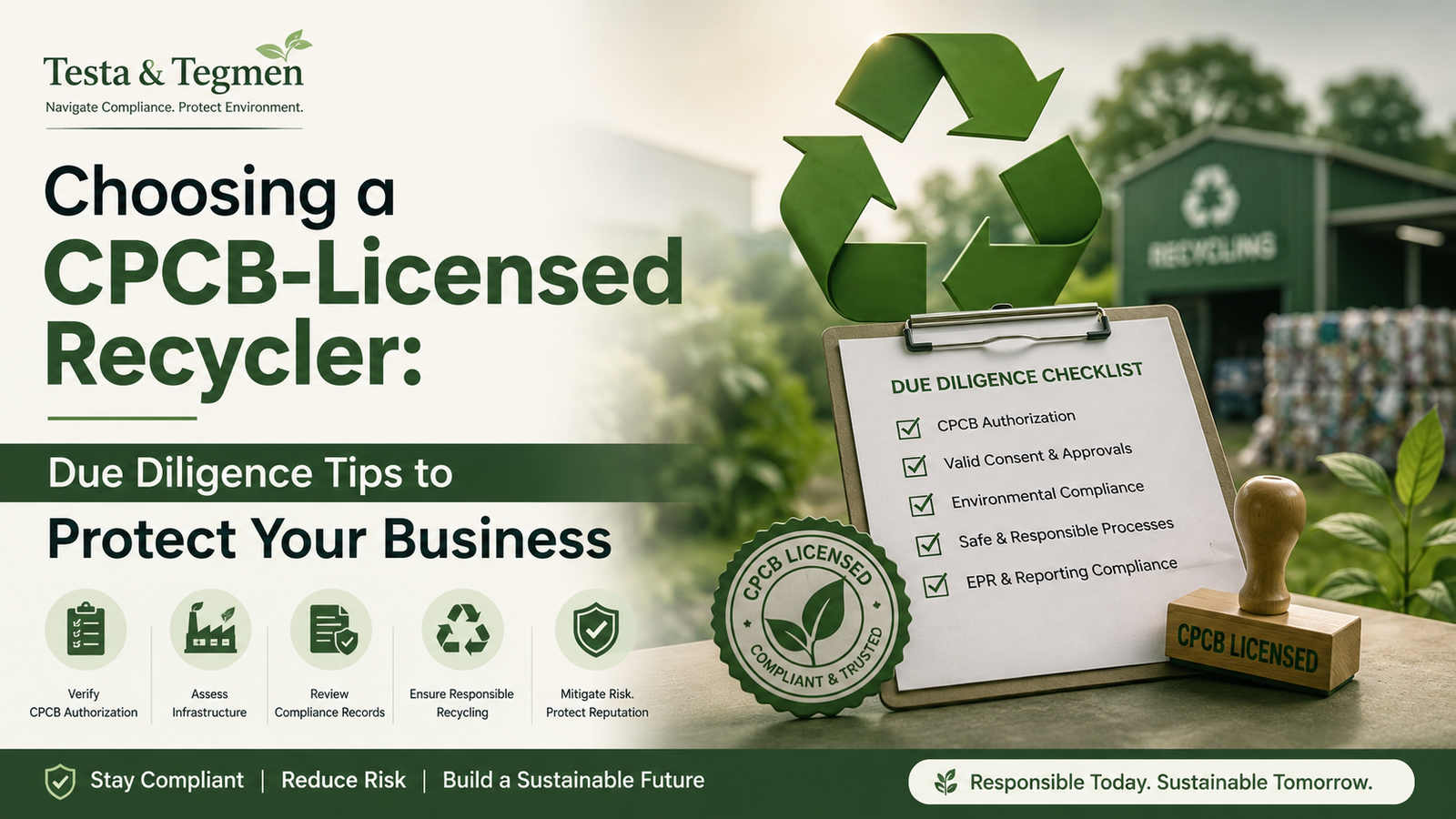
Choosing a CPCB-Licensed Recycler: Due Diligence Tips to Protect Your Business
Choosing the right CPCB-licensed recycler can protect your business from compliance risks, penalties, and reputational damage. Learn key due diligence checks for responsible recycling.
India's formal recycling sector is growing fast, but growth has outpaced verification. Every year, more businesses discover -- usually during an audit, a regulatory notice, or a media exposé -- that the "authorized recycler" they trusted with their electronic, plastic, or hazardous waste was never authorized at all, or was operating far beyond its registered capacity. The financial, legal, and reputational fallout lands squarely on the waste generator, not the recycler. This makes due diligence on your recycling partner one of the more consequential procurement decisions your business will make, not a box-ticking formality.
This guide walks through why CPCB (Central Pollution Control Board) authorization matters, what the current market data tells us about the risks, and a practical, step-by-step due diligence process you can use before signing any recycling or waste-management contract in India.
Why This Matters Now: The Market Context
Formal recycling in India is expanding quickly, but so is the gap between registered capacity and what recyclers actually claim to process. A few figures illustrate the scale of both the opportunity and the risk:
India's e-waste recycling market was valued at roughly USD 1.6-1.7 billion in 2024-25 and is projected to grow at a CAGR of around 6-10% through the early 2030s, with some forecasts placing the broader e-waste management market above USD 15 billion by 2034.
As of early 2025, CPCB's own records listed only 322 registered recyclers and 72 registered refurbishers nationwide for e-waste -- a relatively small formal universe given the scale of demand.
India generates an estimated 1.6-1.75 million metric tonnes of e-waste annually and ranks as the third-largest producer of e-waste in the world, yet an estimated 90-95% of this waste is still handled by the informal, unregistered sector.
Formal recycling capacity is currently estimated to handle less than 40% of total waste generated in the country, leaving a wide gap that unregistered operators and, increasingly, fraudulent "authorized" entities are stepping in to fill.
A joint assessment by the Centre for Science and Environment and CPCB uncovered more than 700,000 fake plastic-recycling certificates in circulation, with some processors reporting volumes many times greater than their registered capacity.
In one Karnataka case, a CPCB audit found a plastic-recycling unit had issued certificates for processing 3.48 lakh tonnes of waste despite the facility never having become operational -- prompting a state-wide inspection of 89 recyclers.
A 2024 CPCB audit of 500 e-waste Producer/Importer/Brand-Owner (PIBO) filings rejected 10-15% of submitted recycling credits due to fraud or documentation gaps.
The takeaway is straightforward: the market is expanding, regulatory scrutiny is intensifying, and fraudulent or non-compliant recyclers are common enough that they show up repeatedly in official audits. Businesses that skip verification are statistically likely to encounter one of these operators sooner or later.
What "CPCB-Licensed" Actually Means
CPCB authorization is not a single, generic stamp. Depending on the waste stream, a legitimate recycler may need one or more of the following:
Registration or authorization under the E-Waste (Management) Rules, 2022, for electronic waste dismantling, recycling, or refurbishing.
Authorization under the Hazardous and Other Wastes (Management and Transboundary Movement) Rules, 2016, for hazardous waste handling, storage, and disposal.
Registration under the Plastic Waste Management Rules for plastic recycling or co-processing, including EPR credit issuance.
A corresponding Consent to Establish and Consent to Operate from the relevant State Pollution Control Board (SPCB), which works alongside -- not instead of -- CPCB registration.
For battery and tyre waste, equivalent authorizations under the Battery Waste Management Rules and Waste Tyre EPR framework.
A recycler that is authorized for one waste category is not automatically authorized for another. This is one of the most common gaps businesses miss: a vendor may hold a valid e-waste registration but no hazardous-waste authorization, yet still accept mixed loads that include batteries, circuit boards, or other regulated hazardous fractions.
The Business Risk of Getting This Wrong
When a recycler turns out to be unauthorized, improperly authorized, or non-compliant, the consequences typically fall on the company that handed over the waste, not the recycler itself. Risks include:
Monetary penalties and environmental compensation charges under the Environment (Protection) Act, 1986, for improper disposal traced back to your organization.
Invalidated EPR certificates, which can retroactively wipe out a year's worth of compliance credits and trigger fresh obligations, audits, or suspension of your own EPR registration.
Data security exposure, particularly for IT asset disposition (ITAD), where devices processed by an uncertified handler may resurface with recoverable data.
Reputational damage if your organization is named in a regulatory list, audit report, or news story tied to a recycling fraud case.
Contractual and shareholder risk where ESG disclosures, CSR claims, or client sustainability commitments rely on recycling data that turns out to be fabricated.
A Practical Due Diligence Checklist
Before signing a contract or handing over your first consignment, work through the following steps. None of these require specialized legal expertise -- they are procedural checks any procurement or sustainability team can run.
1. Verify the registration directly with the regulator, not the vendor
Never rely solely on a certificate PDF or a number printed on a letterhead. Cross-check the recycler's registration or authorization number against the CPCB and relevant SPCB's public portals or EPR databases. Confirm the entity name, registration category (e-waste, hazardous waste, plastic, battery, tyre), authorized capacity, and validity dates match exactly what the vendor has presented. If the registration is expired, under renewal, or scoped to a different waste category than what you intend to send, treat that as a hard stop.
2. Confirm State Pollution Control Board consents
CPCB registration alone is not sufficient operational authority. Ask for the current Consent to Establish and Consent to Operate issued by the SPCB for the specific facility you intend to use, and verify these are active and tied to the correct site address -- not a different plant location owned by the same company.
3. Conduct a physical site visit before onboarding
A facility that refuses a site visit, delays scheduling repeatedly, or only offers a "virtual tour" is a red flag. During a visit, look for: functioning dismantling or processing equipment consistent with the claimed capacity, proper storage segregation for hazardous fractions, weighbridge or scale equipment for inbound material, visible safety and environmental controls (effluent treatment, dust and fume control), and reasonable inventory levels rather than an empty or staged facility.
4. Cross-check claimed capacity against registered capacity
Ask directly what tonnage the facility is authorized to process annually and compare it against what the recycler is telling you (or other clients) it actually processes. The Karnataka case and the CSE-CPCB findings on certificate inflation both stemmed from processors claiming volumes many times higher than their registered or physical capacity. If a vendor's numbers don't add up on paper, they won't add up in an audit either.
5. Request chain-of-custody documentation
A credible recycler should be able to provide manifests, weighbridge slips, transport permits, and processing logs that trace your waste from collection to final disposition or resource recovery. Ask how these records are generated and stored, and whether they are available for your own audit trail -- this documentation is what protects you if your EPR filings or ESG disclosures are ever questioned.
6. Verify EPR certificate issuance history
If your arrangement involves EPR credits, check the recycler's certificate issuance history on the relevant CPCB portal. Look for consistency between certificate volumes and the facility's registered capacity over time, rather than sudden spikes that don't align with any corresponding growth in infrastructure.
7. Ask about downstream and sub-contracted vendors
Many recyclers subcontract certain waste streams (for example, specific metal recovery or final disposal) to third parties. Ask for the names and authorization status of any downstream vendors, and confirm your contract requires the primary recycler to only use similarly authorized sub-processors. Waste that looks properly handled at the first stage can still end up in the informal sector two steps downstream.
8. Check data security and IT asset handling practices (for e-waste/ITAD)
If you're disposing of IT hardware, ask specifically about data destruction standards, certificates of data destruction, and whether the facility can produce serial-number-level tracking for high-value or sensitive assets.
9. Confirm insurance and liability coverage
Ask whether the recycler carries environmental liability or pollution legal liability insurance, and request documentation. This is a reasonable ask for any vendor handling regulated waste on your behalf, and its absence is worth factoring into your risk assessment.
10. Build indemnification and audit rights into the contract
Your agreement should include the right to conduct periodic audits or site visits without extensive notice, warranties that the vendor will maintain valid authorization for the full contract term, an obligation to notify you immediately if any authorization is suspended or under investigation, andindemnification clauses that shift financial liability back to the recycler in cases of misrepresentation or fraud.
Red Flags That Should Pause Any Deal
Registration documents that are photocopies, screenshots, or lack a verifiable certificate/reference number.
Reluctance or repeated delays around scheduling a site visit.
Pricing significantly below market rate for the waste category -- often a sign the recycler is not covering the real cost of compliant processing.
Certificate volumes or claimed throughput that are inconsistent with the facility's visible size or registered capacity.
Registration listed under a different legal entity name, address, or waste category than the one actually handling your material.
No transport permits or manifests provided for waste movement between your site and the facility.
Recycler is unable or unwilling to name its downstream processing partners.
Make Due Diligence an Ongoing Process, Not a One-Time Check
Authorization status can change after onboarding -- a registration can lapse, be suspended following an audit, or be revoked entirely. With CPCB and state boards increasing the frequency of inspections and, in several cases, moving toward quarterly public listings of non-compliant entities, a recycler that was fully compliant at signing may not remain so a year later.
Build a recurring review into your vendor management process: re-verify registration validity annually, request updated capacity and consent documentation at contract renewal, and monitor CPCB or SPCB public notices for any entity on your approved vendor list. Treating this as a continuous compliance function, rather than a one-time procurement step, is what actually protects your business over the life of the relationship.
How to Verify a Recycler's CPCB Status: A Quick Reference
If you only have time for one step before your next vendor call, make it this one. Verification does not require a legal team -- it requires patience and a willingness to cross-check rather than accept documents at face value.
Ask the recycler for their registration or authorization number, the exact legal entity name on the certificate, and the specific facility address it covers.
Search the CPCB and relevant SPCB portals for that registration number and confirm it is active, matches the entity name, and covers the waste category you intend to send.
Check the authorized capacity listed on the registration against what the recycler tells you about their throughput -- a mismatch is worth questioning before you proceed.
Request the facility's most recent inspection or compliance report, if available, and ask whether any show-cause notices or suspensions are on record.
Confirm the SPCB Consent to Operate is current and tied to the same facility, since CPCB and SPCB approvals can lapse independently of one another.
Document each of these checks -- screenshots of portal results, copies of certificates, and notes from any calls -- and keep them in your vendor file. This record becomes your evidence of reasonable diligence if a compliance question arises later.
Frequently Asked Questions
Is CPCB registration the same as an SPCB Consent to Operate?
No. CPCB registration or authorization establishes that an entity meets national requirements for a given waste category, such as e-waste or hazardous waste. The State Pollution Control Board's Consent to Establish and Consent to Operate are separate, facility-specific approvals confirming that a particular site is permitted to run its operations. A recycler needs both, and they should be checked independently, since one can lapse while the other remains active.
What should I do if I discover my current recycler's authorization has lapsed?
Pause shipments to that facility immediately, document the date and nature of the discovery, and consult your legal or compliance team about disclosure obligations. Depending on your EPR filings, you may need to re-file or seek alternative certificates for the affected period. Continuing to ship waste to alapsed facility after discovery significantly increases your own liability exposure.
Do small and mid-sized businesses need to do this level of due diligence, or only large corporates?
Regulatory obligations under EPR and hazardous-waste rules apply regardless of company size, and enforcement actions have touched businesses well below the large-corporate scale. A smaller company may not need a dedicated compliance team, but the core verification steps -- checking registration, requesting documentation, and keeping records -- take a few hours and scale down easily.
How often should I re-verify a recycler I already work with?
At minimum, re-verify at each contract renewal and whenever a registration's stated validity period is due to expire. Many organizations also build in an annual check regardless of contract timing, since registrations can be suspended mid-term following an audit or inspection finding.
Conclusion
India's push toward a formal, accountable recycling ecosystem is real, and the market data shows genuine momentum -- more registered players, tighter EPR enforcement, and growing corporate demand for traceable disposal. But that same data shows a persistent gap between the number of businesses that need compliant recyclers and the number of recyclers who can actually document that they are what they claim to be. Fake certificates, capacity inflation, and unauthorized sub-contracting are not rare edge cases; they are documented, recurring findings in CPCB's own audits.
The businesses that avoid becoming the next cautionary example are the ones that verify registration directly with regulators, insist on site visits, demand documentation at every step of the chain of custody, and treat their recycling partner's compliance as something to monitor continuously rather than confirm once. A few hours of due diligence up front is considerably cheaper than an EPR penalty, an invalidated compliance certificate, or a headline naming your company alongside a recycling fraud investigation.
Related service